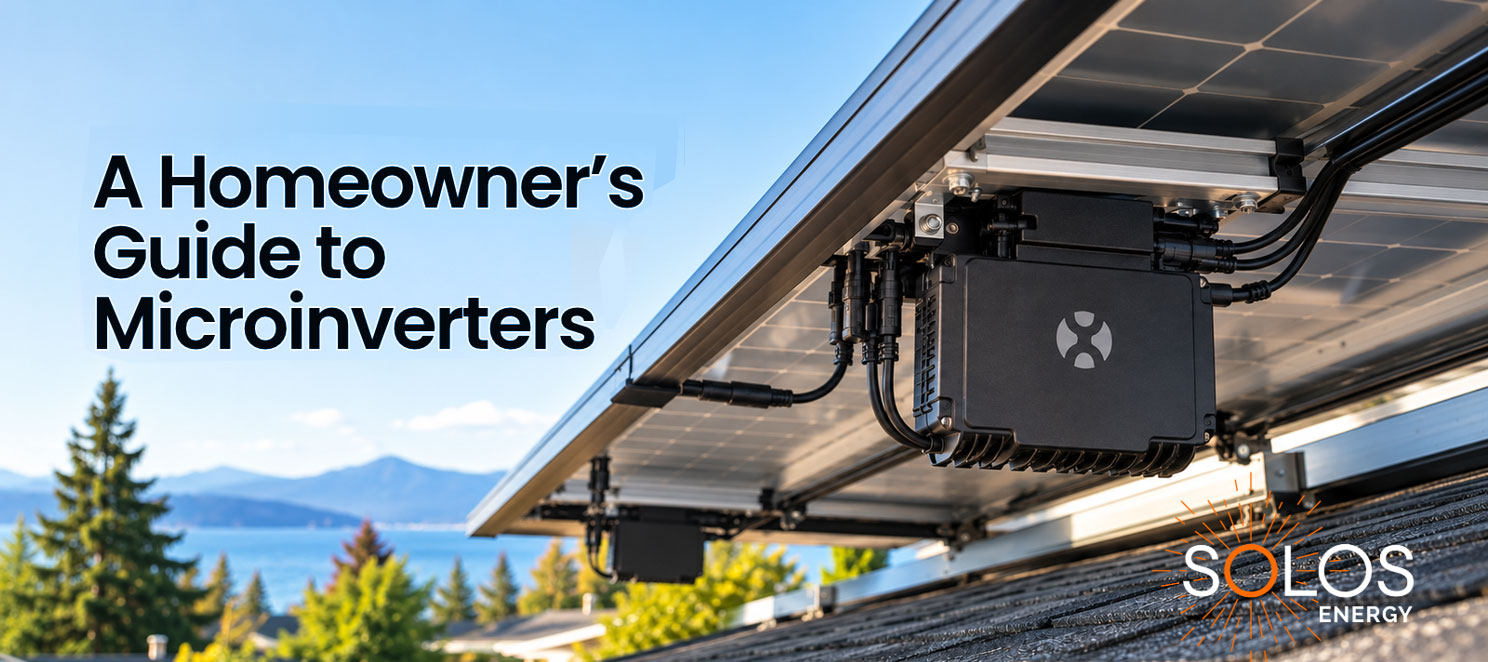
Solar panels generate electricity as direct current (DC), while your home uses alternating current (AC). An inverter converts the electricity from your panels into usable AC power.
Solos primarily uses microinverters for residential solar installations. Unlike a central inverter, microinverters are installed at the panel level, allowing each module to operate more independently and providing detailed performance data.
What Is a Microinverter?
A microinverter converts the DC electricity from a solar panel into AC electricity at the panel level.
Solos primarily uses APsystems DS3-S and DS3-L microinverters. Both are dual-module units, connecting two solar panels with an independent MPPT channel for each module.
This means the two panels can be tracked independently rather than being treated as one combined source.
Why Does Panel-Level Operation Matter?
Solar panels don’t always produce the same amount of electricity. Microinverters allow each panel to operate independently, rather than having one central inverter manage the entire array.
Solos uses APsystems DS3-S and DS3-L microinverters, which have separate MPPT channels for each of their two connected panels. This allows the system to track each panel’s output independently.
When Shading Affects a Solar Array
Trees, chimneys and nearby buildings can shade part of a roof at different times of day.
With a string inverter, shading on one panel can reduce the output of the connected string, depending on the system design.
With microinverters, the effect is more localized: a shaded panel produces less electricity, while the other panels can continue operating independently. This can be especially useful on roofs with partial or changing shade.
Monitoring Your Solar Panels
Microinverters also provide panel-level monitoring.
APsystems’ monitoring platform can show production data for individual modules, making it easier to see how each panel is performing and identify a potential issue.
Instead of only seeing the combined production of the array, homeowners and installers can see where production is changing.
The APsystems Microinverters Solos Uses
Solos primarily uses APsystems DS3-S and DS3-L microinverters in residential installations.
The DS3 series features two independent MPPT channels, natural convection cooling and an IP67-rated enclosure. APsystems lists the series at up to 97% peak efficiency.
The DS3 microinverters are backed by a 25-year warranty in Canada.
Why Solos Uses Microinverters
For residential solar, conditions can vary considerably across a single roof. Microinverters give each panel more independent control and provide detailed information about system performance.
For Solos, that combination makes microinverters a practical choice for residential installations.
The system is still designed around the property itself — including the roof layout, orientation, shading, electricity consumption and available space.
If you’re considering solar for your home, request a free consultation.